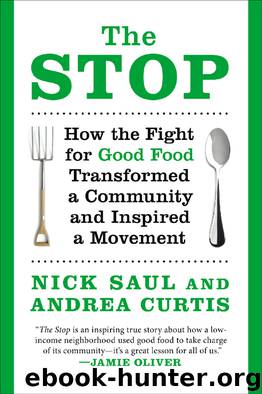
The Stop by Nick Saul
Author:Nick Saul [Saul, Nick]
Language: eng
Format: epub
ISBN: 978-1-61219-350-2
Publisher: Melville House
Published: 2013-09-23T16:00:00+00:00
SIX
BUILD A
BIG TENT
OCTOBER 2007. The tiny courtyard in front of St. Michael and All Angels Church is thronged with activity. White pop-up tents shade tables laden with squash and tomatoes, apples and onions. Milk crates and coolers, a knapsack or two and cardboard boxes stuffed with produce are stacked on the ground underneath. A few vendors selling dried herbs and tinctures have set up a table in the sun. Kids are running around, there are balloons and a banjo player is settling in. I see a woman I recognize from the many Wychwood Barns redevelopment meetings handing out flyers for a fundraising event.
My two boys are tugging impatiently on the leg of my jeans, but I really want to buy some chard from one of the farmers. He’s a wiry guy with a red face and a bush of white, curly hair, a fourth-generation vegetable farmer and an organic pioneer in the region. He was one of the first to sign on with our new farmers’ market, and we were thrilled when he agreed to come. We’re calling it a pilot project, but this market is intended to be one of the bedrock programs at the Green Barn just two blocks south of here. It’s been nearly seven years of talking and planning and raising money for the project, and I can hardly believe it’s almost finished. Once the new site officially opens—with twenty-six live/work units for artists, studios, offices for community groups and environmental organizations, public spaces and a big park with a playground, splash pad, volleyball court and room for a homemade skating rink, not to mention the Green Barn itself—we’ll move the market down there, making it one of the largest year-round farmers’ markets in the city.
Only ten minutes by streetcar from Symington Place, this area couldn’t be more different from our low-income neighbourhood. Skimming the edge of one of the city’s wealthiest enclaves, it takes its character from the main street, St. Clair Avenue. Sitting on top of one of the city’s hills, St. Clair is a mixed bag of ethnicity and income. The stretch closer to The Stop is known as the landing place of the second wave of Italian immigrants. Banners in red, green and white, and street signs—as well as a smattering of Italian restaurants, stores selling Italian goods and one of the best gelato shops in the city—proclaim it Corso Italia. Closer to this church and the Green Barn, it’s more of a cultural hodgepodge: boutiques selling expensive knick-knacks or pretty dresses rub shoulders with Vietnamese nail salons and a Portuguese chicken restaurant. There are a number of new restaurants and specialty food shops, as well as several thrift stores, a Jamaican patty joint and several payday loan stores.
The streets north of St. Clair are treelined and almost entirely residential, with modest but well-tended single-family homes of the solidly middle and upper-middle class. Below St. Clair there are more middle-class families as well as pockets of wealth. Several social housing apartment buildings, rental homes and seniors’ residences complete this very urban mosaic.
Download
This site does not store any files on its server. We only index and link to content provided by other sites. Please contact the content providers to delete copyright contents if any and email us, we'll remove relevant links or contents immediately.
| Anthropology | Archaeology |
| Philosophy | Politics & Government |
| Social Sciences | Sociology |
| Women's Studies |
Cecilia; Or, Memoirs of an Heiress — Volume 1 by Fanny Burney(32558)
The Great Music City by Andrea Baker(32018)
Cecilia; Or, Memoirs of an Heiress — Volume 2 by Fanny Burney(31956)
Cecilia; Or, Memoirs of an Heiress — Volume 3 by Fanny Burney(31941)
We're Going to Need More Wine by Gabrielle Union(19046)
All the Missing Girls by Megan Miranda(16023)
Pimp by Iceberg Slim(14506)
For the Love of Europe by Rick Steves(14121)
Bombshells: Glamour Girls of a Lifetime by Sullivan Steve(14073)
Talking to Strangers by Malcolm Gladwell(13370)
Norse Mythology by Gaiman Neil(13363)
Fifty Shades Freed by E L James(13239)
Mindhunter: Inside the FBI's Elite Serial Crime Unit by John E. Douglas & Mark Olshaker(9339)
Crazy Rich Asians by Kevin Kwan(9291)
The Lost Art of Listening by Michael P. Nichols(7506)
Enlightenment Now: The Case for Reason, Science, Humanism, and Progress by Steven Pinker(7311)
The Four Agreements by Don Miguel Ruiz(6765)
Bad Blood by John Carreyrou(6621)
Weapons of Math Destruction by Cathy O'Neil(6279)
